

he intellectual and developmental disabilities field is asking the wrong question. Across conference halls, board rooms, and late-night staff meetings, the conversation keeps circling back to the same place: how do we find more people? How do we fill these positions? How do we keep paying overtime and still keep the lights on? These are real pressures, and they deserve honest answers. But the question that actually moves an agency forward is different. It is not how do we find more staff. It is how do we build smarter systems that let the staff we have do their best work.
That is what enabling technology IDD does. Not as a futuristic concept or a slide in someone’s conference presentation, but as an operational reality that hundreds of provider agencies across the country are already living. Enabling technology refers to the ecosystem of tools, systems, devices, and methodologies that support individuals with intellectual and developmental disabilities in gaining independence, safety, and quality of life. It includes everything from smart home devices and environmental sensors to remote monitoring platforms and automated reminders. And when implemented well, it transforms not just how agencies deliver services but how individuals experience their own lives.
Who this is for: Executive directors, operations leaders, and IT decision-makers at IDD provider agencies weighing technology investments against staffing realities.
What you’ll learn: What enabling technology actually means (and how it differs from assistive technology), how it restructures workforce economics, what a real implementation strategy looks like, and how to measure outcomes that satisfy regulators, families, and your board.
What Enabling Technology IDD Actually Means
The term enabling technology gets used loosely, and that looseness creates confusion. Some providers hear it and think cameras. Others think Alexa. Some state agencies use it interchangeably with assistive technology, while others draw sharp distinctions. Clearing up this terminology matters because funding, waiver eligibility, and service definitions often depend on which term you use and how your state defines it.
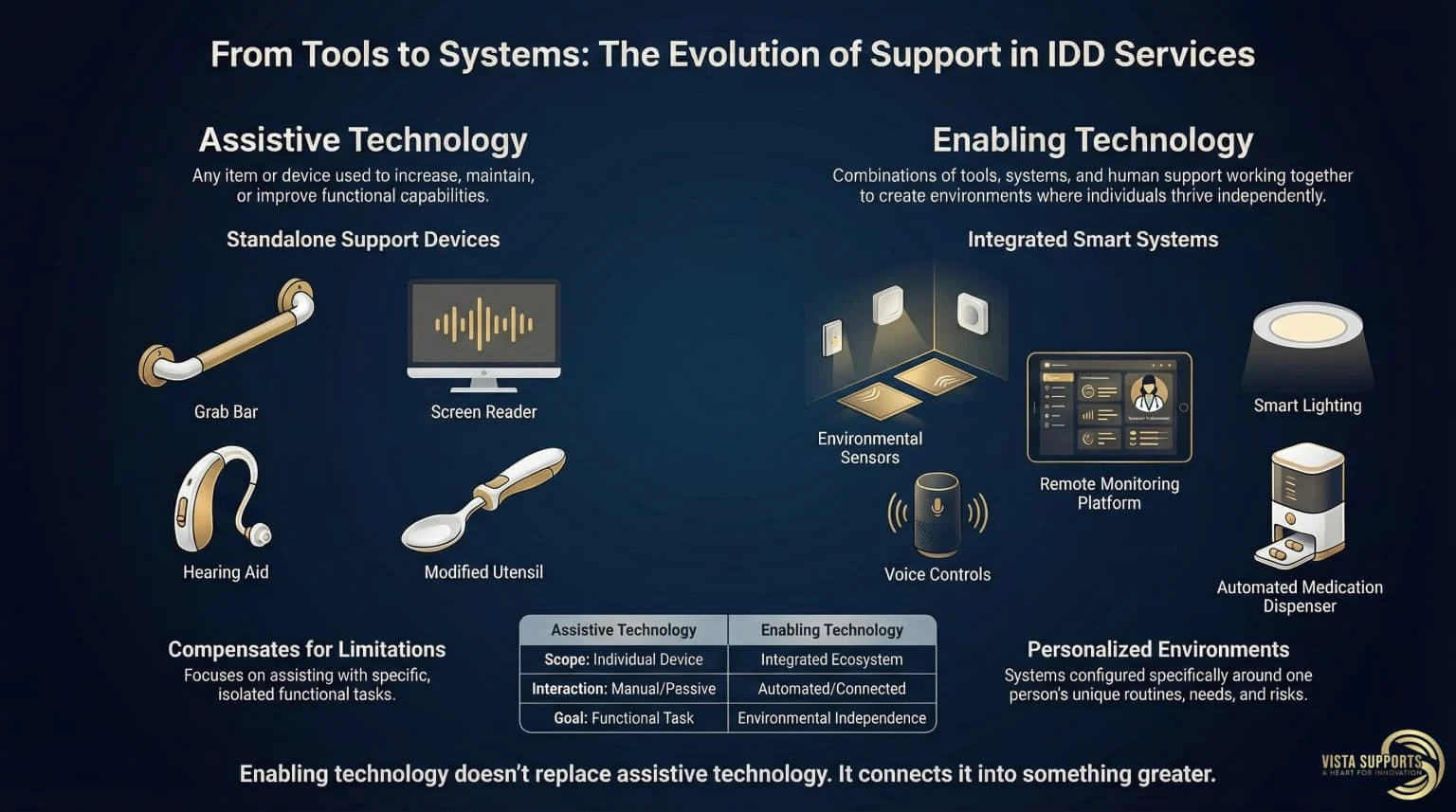
Assistive technology, as defined by federal law through the Assistive Technology Act, refers to any item, piece of equipment, or product system used to increase, maintain, or improve functional capabilities of individuals with disabilities. That is a broad definition, and it covers everything from a wheelchair to a screen reader to a modified kitchen utensil. Enabling technology encompasses that definition and expands it. Where assistive technology focuses on compensating for specific functional limitations, enabling technology IDD takes a systems view. It asks how combinations of devices, platforms, monitoring capabilities, and human support can work together to create environments where individuals thrive with less intrusive, more natural support.
Tennessee’s Department of Disability and Aging coined the term in a way that has become the national reference point. Their Enabling Technology Program defines it as equipment and methodologies that, alone or in combination, provide the means to support individuals’ increased independence in their homes, communities, and workplaces. Ohio built a parallel framework through its Technology First initiative, creating dedicated waiver codes that distinguish between remote support services and assistive technology equipment. The distinction matters for billing, for service planning, and for how person-centered teams think about what is possible.
Think of it this way. A grab bar in a bathroom is assistive technology. A smart home system that includes motion-activated lighting in the bathroom, a fall detection sensor, a voice-controlled faucet, and a remote monitoring connection to a support professional who can check in if the motion pattern looks unusual, all working together and configured around that specific person’s routines and risks, that is enabling technology IDD in practice.
How Enabling Technology IDD Changes the Staffing Math
The workforce crisis in IDD services is structural, not seasonal. Direct support professional vacancy rates exceed 40% at many agencies. Annual turnover runs at similar rates. Medicaid reimbursement has not kept pace with what it costs to attract and retain workers in a labor market where Amazon, Walmart, and fast food chains compete for the same people and often offer better schedules with fewer emotional demands. These are not new observations, but they are deepening every year. Traditional responses, including wage increases, signing bonuses, and recruitment campaigns, have provided temporary relief at best.
Enabling technology IDD does not solve the staffing crisis by eliminating staff. That framing misrepresents both the technology and the values of the field. What it does is fundamentally restructure how staff time gets allocated. In traditional models, agencies deploy direct support professionals based on risk assumptions. Someone is present overnight in a group home because something might happen, not because something is happening. That model made sense before reliable monitoring technology existed. It makes less sense now.
Remote monitoring through enabling technology IDD allows one trained professional at a central location to observe multiple homes simultaneously, intervening when genuinely needed while allowing individuals to navigate routine activities independently. Environmental sensors detect falls, changes in movement patterns, and unusual inactivity. Two-way communication systems connect individuals to support when they want it rather than imposing staff presence when they do not. At Vista Supports, we have guided agencies through this transition and watched the same pattern repeat: staff hours concentrate where they add the most value, in community integration activities, skill development, relationship building, and crisis response, rather than in passive overnight presence.
The financial impact flows through multiple channels. Direct overnight staffing costs decrease when appropriate individuals transition to remote monitoring. Overtime and premium pay decline as total required hours decrease. Turnover costs drop because remaining positions often offer better schedules and more meaningful work. And new role categories open up. Remote monitoring positions attract workers who cannot perform the physical demands of traditional DSP work but bring valuable skills to disability services, including parents needing home-based work, students seeking flexible schedules, and experienced professionals seeking reduced physical demands.
Building an Enabling Technology IDD Strategy That Actually Works
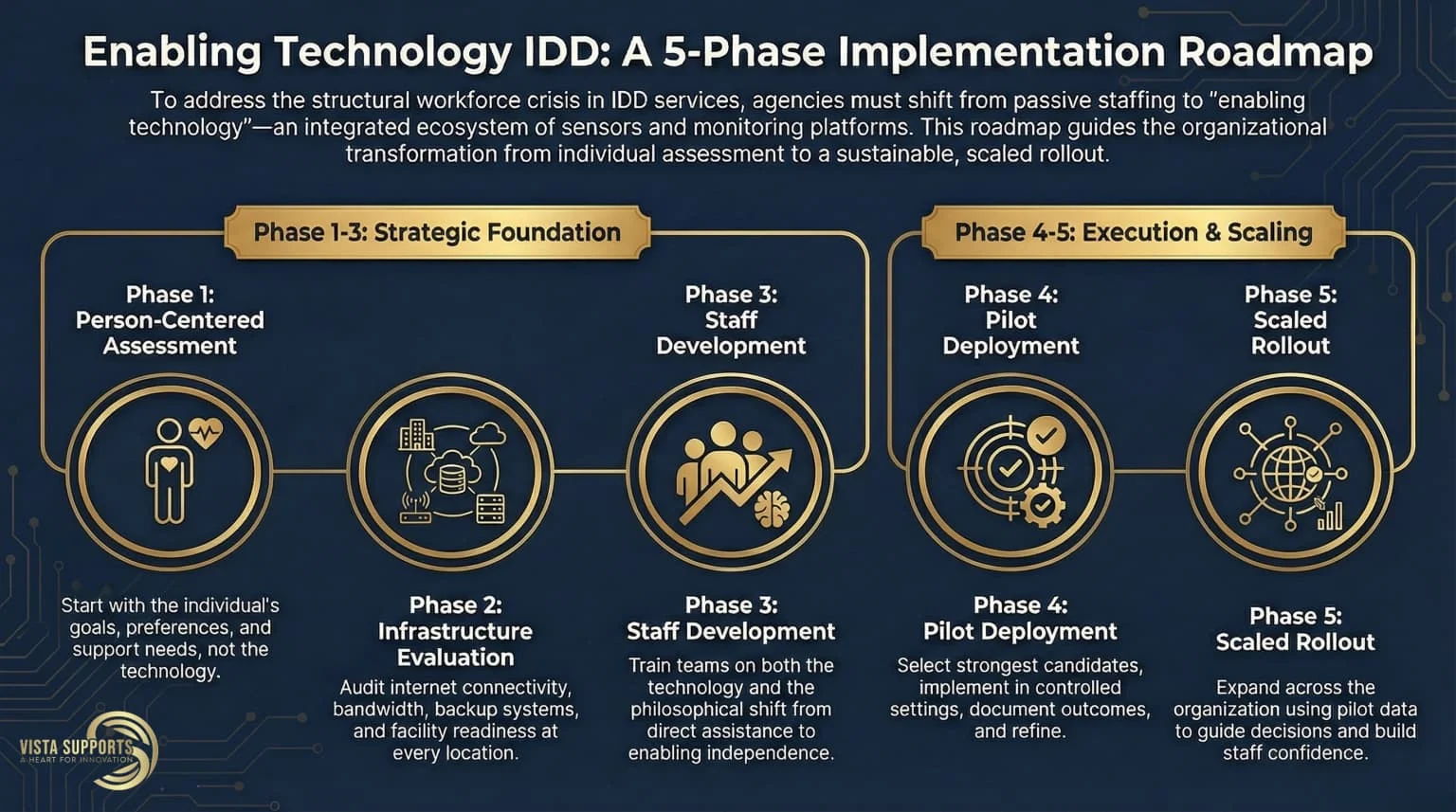
Technology purchases without strategy produce expensive shelf decorations. The agencies that succeed with enabling technology IDD treat implementation as organizational transformation rather than equipment acquisition. That transformation has several dimensions that deserve serious attention before any device gets installed.
Start with the Person, Not the Technology
Every enabling technology IDD implementation should begin with individual assessment rooted in person-centered planning. The question is never what technology can we install in this house. The question is what does this person want their life to look like, what support needs do they have, and how can technology help close the gap between where they are and where they want to be. When someone’s Individual Support Plan emphasizes independence in meal preparation, the technology configuration focuses on kitchen safety and cooking support rather than blanket surveillance of every room. When someone values privacy in their bedroom but worries about falling in the bathroom, the sensor configuration reflects those specific preferences. This is not just good practice. It is what regulators expect, what families deserve, and what makes enabling technology IDD actually work.
Assess Your Infrastructure Honestly
Reliable internet connectivity at every monitored location is non-negotiable. Video transmission, real-time sensor data, and two-way communication all require adequate bandwidth that many residential settings, particularly in rural areas or older housing stock, do not currently have. Cellular backup systems provide redundancy, but primary connectivity must support continuous operation. Agencies that skip this assessment discover the hard way that the most sophisticated monitoring platform in the world is useless when the internet goes down at 2 AM.
Invest in Staff Development Before Equipment
Direct support professionals accustomed to in-person care delivery need more than technical training on how to operate a dashboard. They need to understand the philosophical shift from providing direct assistance to enabling independence. That shift changes what good support looks like. In a traditional model, a DSP who helps someone make a sandwich is doing their job. In an enabling technology model, a DSP who steps back and lets the smart home reminder system guide someone through sandwich preparation, intervening only if the stove sensor detects a safety concern, is doing something harder and more valuable. Building that understanding takes intentional development, not a one-hour training module.
Where Enabling Technology IDD Policy Is Moving
Understanding how different states approach enabling technology IDD helps agencies navigate their own implementation paths. The landscape is evolving quickly, with more than 40 states now engaging with Technology First concepts in some form.
Ohio remains the national benchmark. The Ohio Department of Developmental Disabilities established clear guidelines for remote support services and created dedicated waiver codes that simplify billing and ensure appropriate reimbursement. Ohio distinguishes between active remote supports with real-time monitoring capability and passive supports based on sensor alerts. That clarity has driven adoption across hundreds of provider agencies with documented outcomes including reduced emergency room visits and improved quality of life indicators.
Tennessee integrated enabling technology into its broader Employment and Community First initiative, making technology assessment a standard part of the person-centered planning process from initial evaluation forward. Rather than treating technology as a standalone service, Tennessee ensures that individuals and their teams consider enabling technology options before defaulting to traditional staffed services. The state’s Enabling Technology Program provides training, resources, and implementation support that has become a model for other states.
States like Maryland, Virginia, and others in the mid-Atlantic region represent emerging markets where regulatory frameworks are still developing. Early adopters in these states have the opportunity to shape policy as it forms. And across the country, the federal emphasis on home and community-based services continues to create momentum for enabling technology IDD as a sustainable alternative to facility-based care.
What a Smart Support Environment Actually Includes
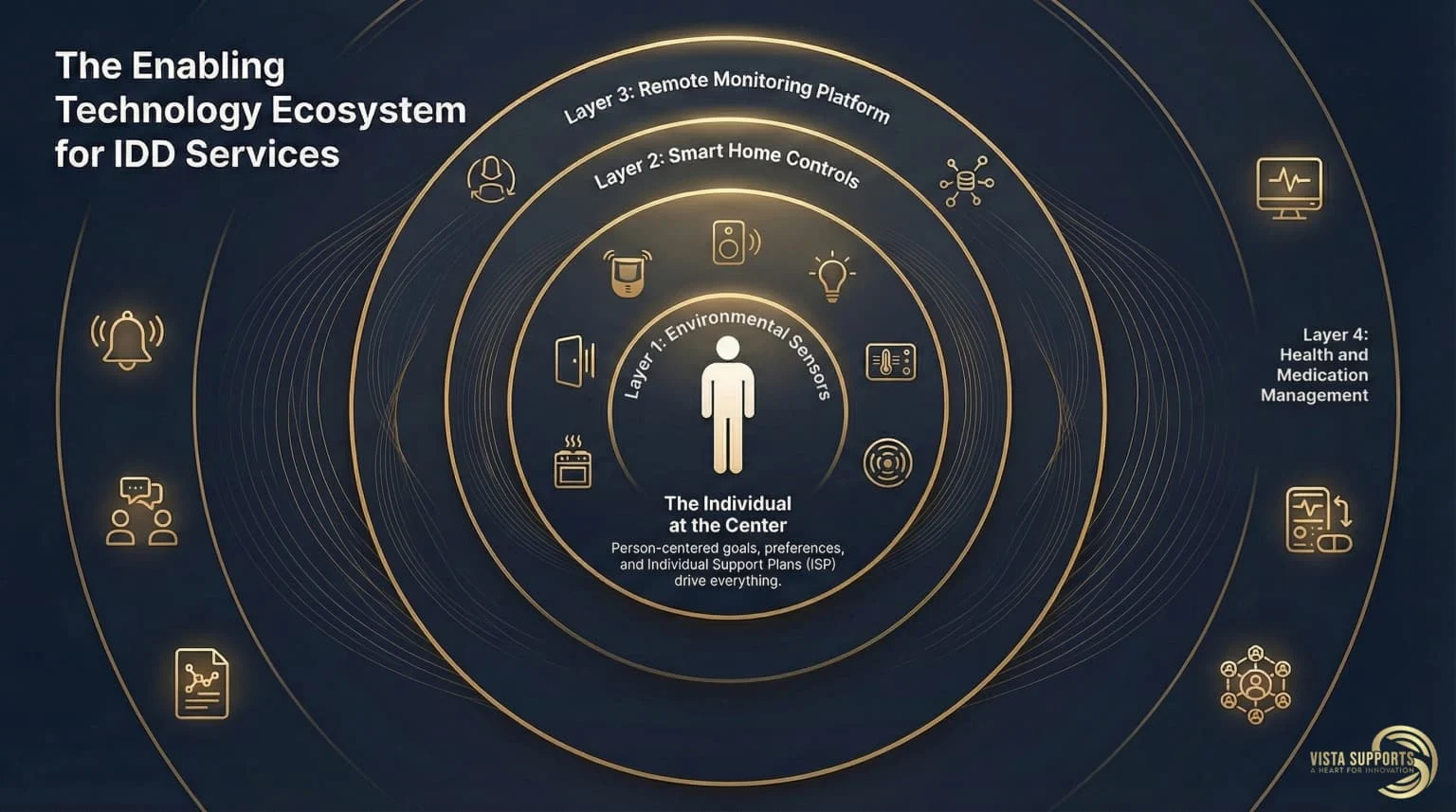
A comprehensive enabling technology IDD implementation draws from multiple technology categories working in concert. Understanding these categories helps agencies and person-centered teams make informed selections.
Environmental sensors form the safety foundation. Motion detectors, door and window sensors, water leak detectors, stove monitors, and temperature sensors create awareness of what is happening in a home without requiring camera surveillance. Radar-based systems like those from Xandar Kardian represent the next evolution, detecting falls, tracking sleep patterns, monitoring respiratory rates, and identifying unusual activity patterns without capturing any visual imagery. For individuals and families who reject cameras as intrusive, radar monitoring provides safety assurance while respecting privacy.
Smart home controls give individuals direct power over their environment. Voice-activated systems through platforms like Amazon Alexa or Google Home enable someone with mobility limitations to manage lighting, temperature, entertainment, and communication without physically reaching switches or devices. Automated lighting eliminates the dangerous gap between waking and reaching a light switch. Smart thermostats maintain safe temperature ranges while optimizing energy costs. These are not luxury additions. For many individuals, they represent the difference between independence and dependence on staff for basic daily activities.
Remote monitoring platforms tie everything together. These systems aggregate sensor data, enable two-way audio and video communication, generate alerts based on configurable parameters, and provide documentation that supports both regulatory compliance and quality improvement. The platform is where raw technology becomes meaningful support, where a motion sensor reading becomes a decision about whether someone needs assistance, and where that decision gets made by a trained professional who understands the individual.
Medication management technology addresses one of the most common challenges for individuals managing health conditions. Automated dispensers organize medications, provide reminders, and track adherence. Integration with monitoring platforms alerts support teams when doses are missed, enabling intervention before health consequences develop.
How to Measure Enabling Technology IDD Success Across Four Dimensions
Agencies that measure enabling technology IDD success purely in cost savings miss the point and eventually lose stakeholder support. The most sustainable implementations track outcomes across four dimensions.
Individual outcomes come first. Are people achieving their ISP goals at rates comparable to or better than those in traditional staffed settings? Are behavioral incidents, medical emergencies, and hospitalizations decreasing? Are individuals and families reporting satisfaction with their support experience? Are people gaining measurable independence in daily living skills? These questions matter more than any financial metric because they represent the fundamental purpose of the work.
Staff outcomes reveal sustainability. Enabling technology should correlate with improved retention, reduced overtime, and higher job satisfaction. If technology implementation creates resentment, confusion, or increased turnover, long-term viability becomes questionable regardless of short-term savings. The goal is role transformation that makes work more meaningful, not job elimination that makes people afraid.
Operational metrics provide the business case. Staffing efficiency gains, turnover cost avoidance, overtime reduction, and Medicaid billing accuracy all contribute to financial sustainability. These numbers matter because agencies that cannot remain financially viable cannot serve anyone. But they are a means to an end, not the end itself.
Regulatory compliance validates the model externally. Survey findings, licensing reports, and quality assurance reviews should demonstrate that enabling technology IDD maintains or improves compliance. Agencies that cut corners on quality while implementing technology often face regulatory consequences that eliminate any financial benefit.
The Future Is Already Here
Artificial intelligence and machine learning are beginning to shift enabling technology IDD from reactive to predictive. Rather than detecting a fall after it happens, emerging systems analyze movement patterns and environmental conditions to identify elevated risk before incidents occur. Rather than alerting to a missed medication, intelligent systems learn individual patterns and flag deviations that may indicate health changes requiring clinical attention. These capabilities are not theoretical. They are being piloted now, and they will define the next generation of enabling technology IDD.
Perhaps equally important is the generational shift among individuals receiving services. Younger adults with intellectual and developmental disabilities have grown up with smartphones, smart speakers, and connected devices as natural parts of daily life. Enabling technology IDD that leverages these familiar tools may feel more comfortable and empowering than traditional staffing models that some individuals experience as intrusive. The conversation is changing from whether technology has a role in IDD services to how we ensure everyone who wants it can access it.
Taking the Next Step
Enabling technology IDD represents a fundamental shift in how provider agencies deliver services, how individuals experience support, and how the field thinks about independence. The technology is available. The regulatory landscape is developing. The workforce crisis makes the status quo untenable. What remains is the strategic commitment to implement well, with the person at the center and the right expertise guiding the process.
Providers support people. Vista supports providers. Vista Supports specializes in helping IDD provider agencies implement enabling technology solutions that satisfy regulators, engage staff, and improve outcomes for individuals served. Our Vista Link platform provides person-centered enabling technology that follows the individual, not the provider, integrating with ISP requirements and Medicaid billing structures. Our Vista Enterprise partnership model provides the strategic guidance, technical expertise, and implementation support necessary for sustainable success. We build agency capability rather than dependency. And when Vista’s work is done, the agency is stronger, not stranded.
Ready to find out where your agency stands? Schedule an enabling technology readiness review with Vista Supports and walk away with a clear picture of your infrastructure gaps, your strongest candidates for pilot deployment, and a realistic cost-benefit snapshot for your board.