Precious “Preciosa” Myers-Brown with Steven Simms
Most people remember The Jetsons for the flying cars. Fair enough. But if you work in disability or aging services and you watch that show now, you notice something else entirely. You notice that their entire world runs on what we would call enabling technology, and nobody in Orbit City thinks twice about it.
George Jetson sits at a console all day, remotely operating a central data system called R.U.D.I. Jane calls the family doctor on a video screen from the living room instead of driving to a clinic. George swallows a tiny robotic capsule called the Peekaboo Prober that beams live diagnostic images to a physician watching on a screen in another location. The house adjusts itself. Rosie handles the daily environment so the humans can focus on living.
None of that was ever really about flying cars. It was about a world where technology extended human capability, tracked health without physical contact, and connected people to support from a distance. That is enabling technology. That is remote supports. The Jetsons just never had the language for it, and they certainly never had to file it under a Medicaid waiver.
In disability and aging services, enabling technology is the infrastructure that makes independence possible when traditional staffing models are stretched past breaking. It is the sensor that catches what a sleeping overnight staff person cannot. It is the platform that lets a nurse review respiratory data from across the state. It is the ecosystem of smart devices, radar sensors, communication tools, and clinical intelligence that wraps around a person’s life without wrapping them in restriction. The Jetsons showed us the vibe. Our work is to build the real thing for people who were never centered in that cartoon’s future.
Enabling Technology Has Always Been the Point
The term enabling technology gets used a lot now, and it should. But it is worth slowing down to understand what it actually means and why it matters more than the buzzwords it sometimes competes with.
Enabling technology refers to the combination of devices, platforms, and systems that allow a person to live more independently, safely, and with greater self-direction. It is not the same thing as assistive technology, though the two overlap. Assistive technology tends to describe a specific device that compensates for a specific limitation: a wheelchair, a communication board, a hearing aid. Enabling technology describes the broader ecosystem that surrounds a person’s life and amplifies what they and their support team can do together. It includes smart home devices, remote support systems, radar-based vital sign sensors, automated medication dispensers, AI companions, predictive analytics, and the platforms that tie all of it into a coherent picture.
The Jetsons understood this distinction intuitively even if they never articulated it. Rosie the Robot was not assistive technology for a specific disability. She was an enabling technology layer across the entire household, handling environmental management so the family could focus on relationships, work, and living. The house itself was the technology. The screens were the technology. The systems that connected George to R.U.D.I. at Spacely Space Sprockets were the technology. Everything worked together.
In the real world of IDD and aging services, that same principle applies. A radar sensor in a bedroom is powerful. But a radar sensor connected to a platform that feeds data to a Remote DSP who can see the alert, review the pattern, and contact the person or escalate to a nurse in real time, that is an enabling technology ecosystem. One device is a tool. The ecosystem is a transformation.
George Jetson Was a Remote DSP and R.U.D.I. Was the First Platform
George’s official title is Digital Index Operator. His entire job involves sitting at a terminal, interacting with R.U.D.I. (the Referential Universal Digital Indexer), and managing information that keeps the operation running. He does not build the sprockets. He does not stand on the factory floor. He operates a centralized system from a remote console, responds to what the data shows him, and makes decisions based on what the technology tells him is happening.
That is a Remote Direct Support Professional. Or a remote nurse. Or a technology coordinator. Whatever title your agency uses for the person who sits at the remote support station, reviews sensor data, takes video calls from individuals in their homes, and decides when to escalate and when to let independence do its work, George Jetson had that job in 1962.
R.U.D.I. itself is the cartoon ancestor of every centralized platform in our field. It is the single system where all the data lives, where the operator logs in, and where decisions get made. In our world, VistaLink™ serves that function. VistaLink™ is the Vista Supports platform that lets provider agencies run their own remote supports with their own Remote DSPs and nurses, instead of handing that role to an outside remote support company. Their teams access everything they need on a single screen: sensor data, alerts, communication tools, documentation, and the interpretive intelligence that turns raw signals into meaningful support decisions. If R.U.D.I. was the brain of Spacely Space Sprockets, VistaLink™ is the brain of the enabling technology ecosystem for the providers we serve.
Telehealth Before It Had a Name: The Jetsons and Remote Health Support
In one well-known episode, George goes to the doctor and swallows a tiny robotic pill called the Peekaboo Prober. The capsule travels through his body while a physician watches live diagnostic images on a screen from another room. There is no stethoscope, no manual blood pressure cuff, no hands on the patient. The data collection is autonomous. The physician reviews what the technology shows and makes clinical decisions from a distance.
That is remote health support and telehealth compressed into a sixty-second cartoon gag. And it maps directly onto two modern realities in disability and aging services.
The first is remote diagnostics through telehealth services like StationMD, a physician group built specifically for individuals with intellectual and developmental disabilities. StationMD provides virtual urgent and primary care so that people can see a doctor from their home rather than enduring the disruption, cost, and risk of an emergency room visit. During the pandemic, this was not theoretical. It was lifesaving. Steven Simms, RN, Vista Supports co-founder and Chief Heart of Innovation, sat on a team that was connecting individuals with I/DD to StationMD and broader telehealth services while simultaneously converting more than sixty homes to remote supports and health-focused enabling technology during the most serious health crisis of our generation.
Those were homes supporting people with complex medical needs at a time when staffing was fragile, infection risk was everywhere, and the world was figuring out in real time how to keep vulnerable populations safe. Steven’s team integrated touchless sensors, remote support, and smart home technology into those environments so that changes in breathing, sleep patterns, and daily movement could flag potential symptoms before anyone could see them with the naked eye. Data points from those systems helped nurses and practitioners decide who needed a check-in first, who needed a physician call, and when to escalate. People stayed home. People stayed stable. Technology did what hallway checks at three in the morning never could.
For Steven, enabling technology and remote supports are not industry talking points. Steven credits those tools, and the teams using them, with helping people stay safe through a period when traditional service models were under extraordinary pressure. That experience is what he carries into Vista Supports every day as the clinical voice that ensures technology decisions always serve health, safety, and human dignity.
Touchless Sensors and the Jetsons’ Automated Exam Room
The Jetsons loved showing automated exam rooms. A person stands in one spot and machines quietly scan, measure, and report while the physician reads results on a screen and makes decisions without performing every routine task by hand. The technology handles the data collection. The human handles the interpretation and the care.
Watching Carl Hernandez, Vista Supports co-founder and Chief OWL, work with providers to implement touchless radar sensors feels remarkably similar. A radar sensor of this kind reads micro-movements, heart rate, respiratory rate, and presence without the person wearing any equipment at all. It sits in the room, not on the body. The individual simply lives their life while the sensor quietly tracks patterns over time. No wearable to forget. No camera to resist. No physical contact required.
Carl spends his days helping provider teams understand what those patterns mean, how to set thresholds, when the data should trigger an alert, and how to connect those insights back into VistaLink™ so the information becomes actionable rather than decorative. He is the person who built the first remote support center for IDD services in the DMV region and trained its first remote support team, and that hands-on implementation expertise is what turns a sensor on a wall into an enabling technology ecosystem that actually changes outcomes.
The Jetsons imagined rooms that automatically read your body and sent the results to someone who could act on them. A touchless radar sensor does exactly that, measuring heart and breathing rates while the person is at rest, in real homes, for real people with real health conditions. No cartoon sound effects. Just quiet, medical-grade intelligence working in the background while someone sleeps, breathes, and lives. These readings help inform care decisions; the sensor does not diagnose illness.
Rosie, Joy AI, and the Brava Oven: Enabling Technology in the Living Room and Kitchen
Not every piece of enabling technology belongs in a clinic or remote support center. A lot of it belongs in the kitchen and the living room, where daily independence actually happens.
Rosie the Robot was never just comic relief. She was an environmental management system with personality. She powered up the home, kept track of routines, prepared meals, and kept the household running so the family could focus on being a family. She was the enabling technology layer that made the Jetsons’ life functional.
Today, tools like OnScreen Joy AI sit in that same lane. Joy shows up on a television or tablet screen as a conversational AI companion that provides reminders, wellness check-ins, and automated video calls. For seniors and people with disabilities, the value is not the novelty. It is that Joy removes the technical barriers that often prevent people from connecting with family, care teams, or physicians. The Jetsons’ videophone was in every room, always ready, always simple. Joy brings that same effortless communication to people who might otherwise be isolated by complexity or cognitive processing differences.
In the kitchen, the Jetsons had the Food-a-Rac-a-Cycle, a machine where Jane pushed one button and a complete meal appeared. The Brava smart oven is the closest modern parallel. It uses an internal camera, temperature sensors, and programmed light-based cooking to reduce guesswork once food is prepared and loaded. Safe handling and support tailored to the person still matter. For a person we support who wants to prepare their own meals but whose team worries about stove safety, the Brava is not a luxury gadget. It is an enabling technology tool that turns a safety concern into an independence opportunity.
Update, October 19, 2026: Brava stopped normal business operations on March 6, 2026, and no longer sells new ovens. Existing cloud and recipe services remain available for now, but continued service, repairs and parts are uncertain, and no further software or accessibility updates are planned.
When Joy AI and the Brava oven live inside the Vista ecosystem alongside radar sensors, smart home controls, and the VistaLink™ platform, they stop being individual products and start becoming pieces of a person-centered enabling technology strategy. Each one addresses a real barrier. Together, they create a home that quietly says what every good support plan should communicate: you can do this, and we are here if you need us.
The Fine Print the Jetsons Never Showed
The Jetsons sold us a future where you pushed a button and everything worked. What they never showed was the fine print.
They never showed who ensures that enabling technology serves people with disabilities and seniors rather than controlling them. They never addressed consent, self-determination, or what happens when technology decisions get made for convenience rather than person-centered outcomes. They never talked about Medicaid reimbursement rates that have not kept pace with the cost of innovation, or about the workforce crisis that makes enabling technology a necessity rather than an option. They never wrestled with the cultural dynamics of care in communities where family sacrifice has been the only model anyone knows.
That is the work we do at Vista Supports. It is the work that separates enabling technology as a philosophy from enabling technology as a product someone drops on a shelf and walks away from.
Our team does not install gadgets. We design ecosystems where technology, data, clinical intelligence, workforce development, and regulatory compliance move in the same direction. VistaLink™ is the platform. Care Daily AI is a technology partner. Xandar Kardian provides the touchless eyes. StationMD and Joy AI extend the care team. The Brava oven and smart home devices handle the daily living environment. And Vista Enterprise is the Human Intelligence behind VistaLink™: the strategic guidance, implementation support, and ongoing partnership that make it possible for a provider to run its own remote supports program, so enabling technology actually works rather than becoming expensive equipment that nobody uses.
Providers support people. Vista supports providers. That sentence means something specific. It means that when a provider agency partners with Vista, we do not become their remote support staff, and we do not replace their expertise or create dependency on ours. The agency’s own team delivers the remote supports. VistaLink™ gives them the platform to do it, and Vista Enterprise gives them the support behind it. We are building their capability so that when our work together reaches its natural conclusion, the agency is stronger, more capable, and more technologically fluent than before. Not stranded. Not renting a system they cannot operate without us. Stronger.
From Saturday Morning Cartoons to Monday Morning Strategy
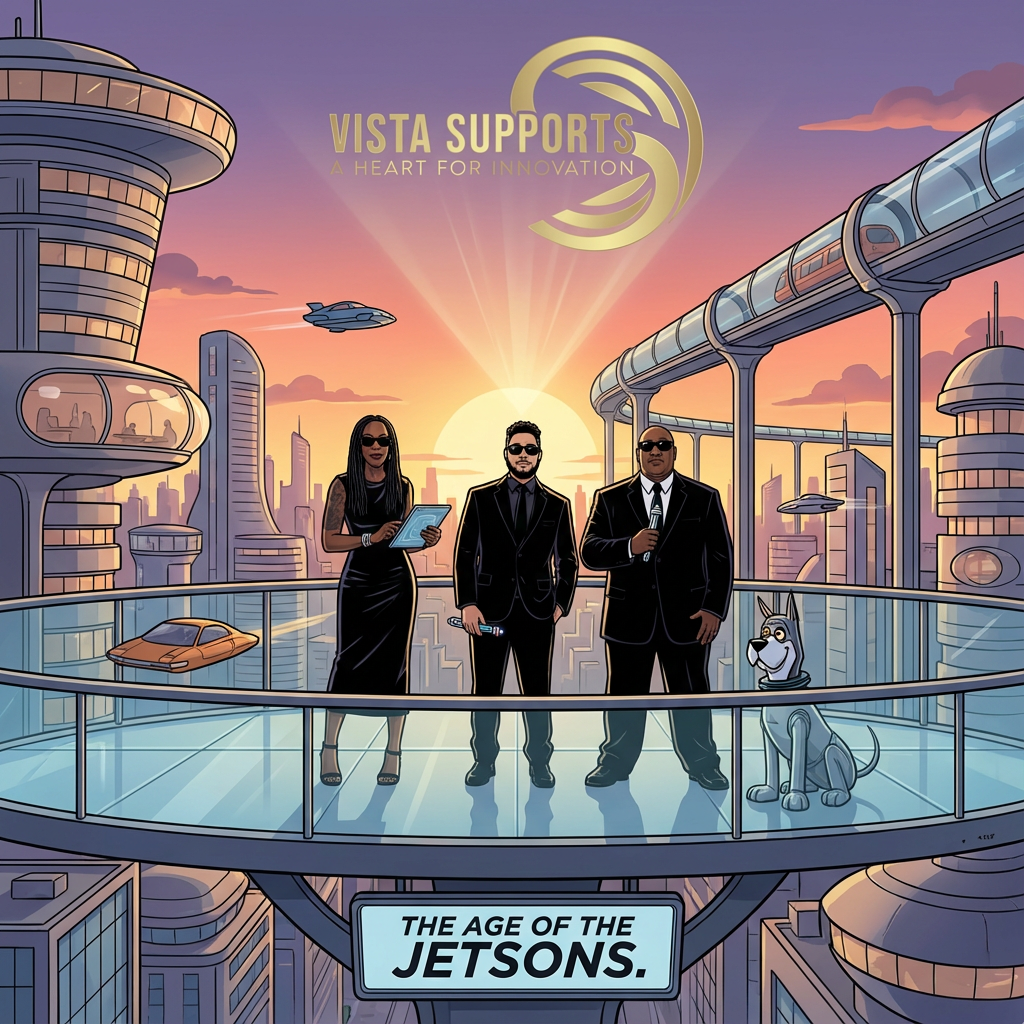
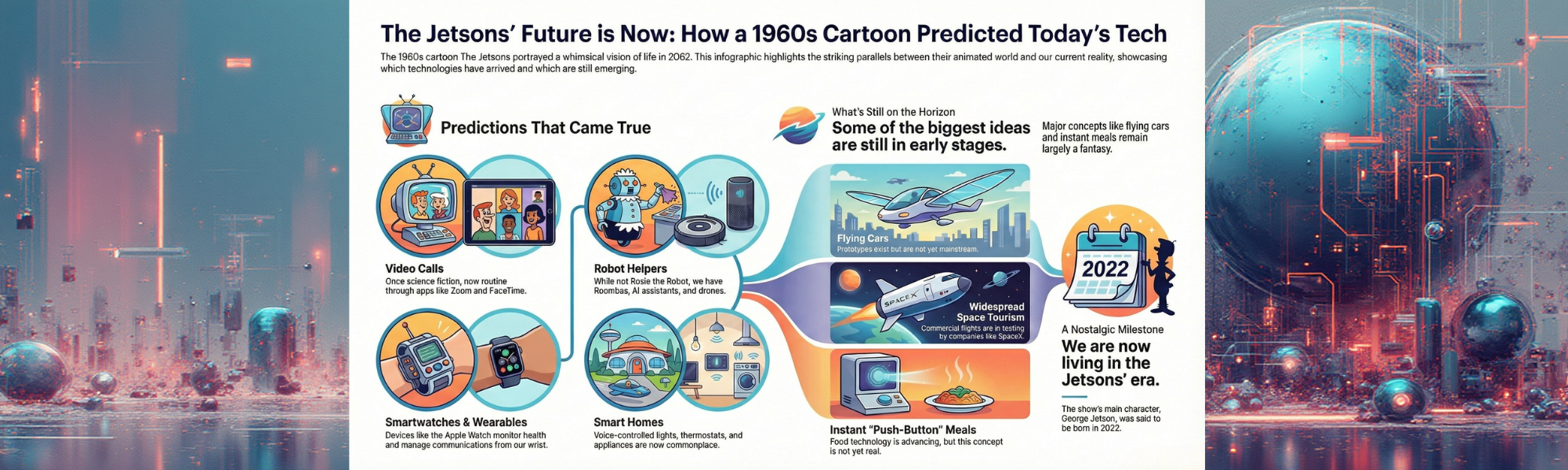
George Jetson was born in 2022, according to the show’s timeline. That means we are officially living in the era The Jetsons imagined. The video calls are here. The smart homes are here. The remote support, the touchless vital-sign sensing, the AI companions, the automated kitchens. All of it is here.
What is also here is the unfinished work of making sure that future includes the people it was never designed for. People with intellectual and developmental disabilities. Seniors aging in place with complex needs. Families navigating systems that were built for a different era. Direct support professionals who deserve tools that make their work meaningful rather than impossible.
Enabling technology is the bridge between the Jetsons’ optimism and the reality of services today. It is not a side project or a nice-to-have line item. It is the infrastructure that determines whether provider agencies can sustain quality services as workforce pressures intensify, reimbursement rates lag, and the people we support rightfully demand more independence and more choice in how their lives are supported.
The Jetsons guessed the gadgets. Our responsibility is to build the ecosystem around them, with heart, with clinical precision, and with the unwavering belief that the people who were never in the cartoon deserve the best version of the future it promised.
If you are a provider, policymaker, or partner who sees the potential of enabling technology and wants to build it thoughtfully, Vista Supports would be honored to be in that conversation with you.
About the Authors
Precious “Preciosa” Myers-Brown
Precious “Preciosa” Myers-Brown is Founder, CEO, and Chief Innovation and Dream Officer of Vista Supports, The Voice of Enabling Technology™, and author of Tech Equity: Freedom Through Enabling Technology. She serves on the board of TechQuity, is President of the DC Coalition of Disability Service Providers, and sits on the ANCOR Foundation board. Her work asks one recurring question of every technology: what does this technology enable a human being to do?
Steven Simms
Steven “Stevo” Simms is Co-Founder and Chief Heart of Innovation at Vista Supports. An RN with 30 years of nursing experience, beginning in cardiology, CDDN certification through DDNA, and CAPS credentials, he bridges the gap between clinical care and enabling technology.